The best way to spend some free time? Travel somewhere new, learn something with your hands, meet good people, get a little lost, and experience a different way of living.
I had wanted to visit Cob for quite a while, especially after meeting Christos twice before. The first time was while volunteering to create the first syntropic garden in Bulgaria, at Damyanitsa. Then our paths crossed again when he was one of the people leading my PDC at Tramonti in Italy.
So when Misha told us about the opportunity to spend two weeks at Cob, the timing was almost suspiciously perfect. I was between jobs, Polya was in her second year of maternity leave, our young daughter Yana was hungry for new experiences, and we thought: why not? We packed our things and headed south.
The road to Cob
On our way out of Sofia, we picked up Noah, a lovely Dutch guy who was travelling in the same direction. Sharing the ride made the journey a little more sustainable and a lot more fun.
We talked for hours while the landscape slowly changed outside the windows. And, being Bulgarian, I naturally took it upon myself to point out and explain every mountain range we could see along the way — first through Bulgaria and then into Greece.
Not a bad way to spend a road trip.
An oasis among the almond fields
Arriving at Cob was a bit surreal.
After driving through seemingly endless almond fields, we suddenly found ourselves inside a green little universe of its own. The place felt somewhere between a forest garden, an experimental village and a hobbit settlement.
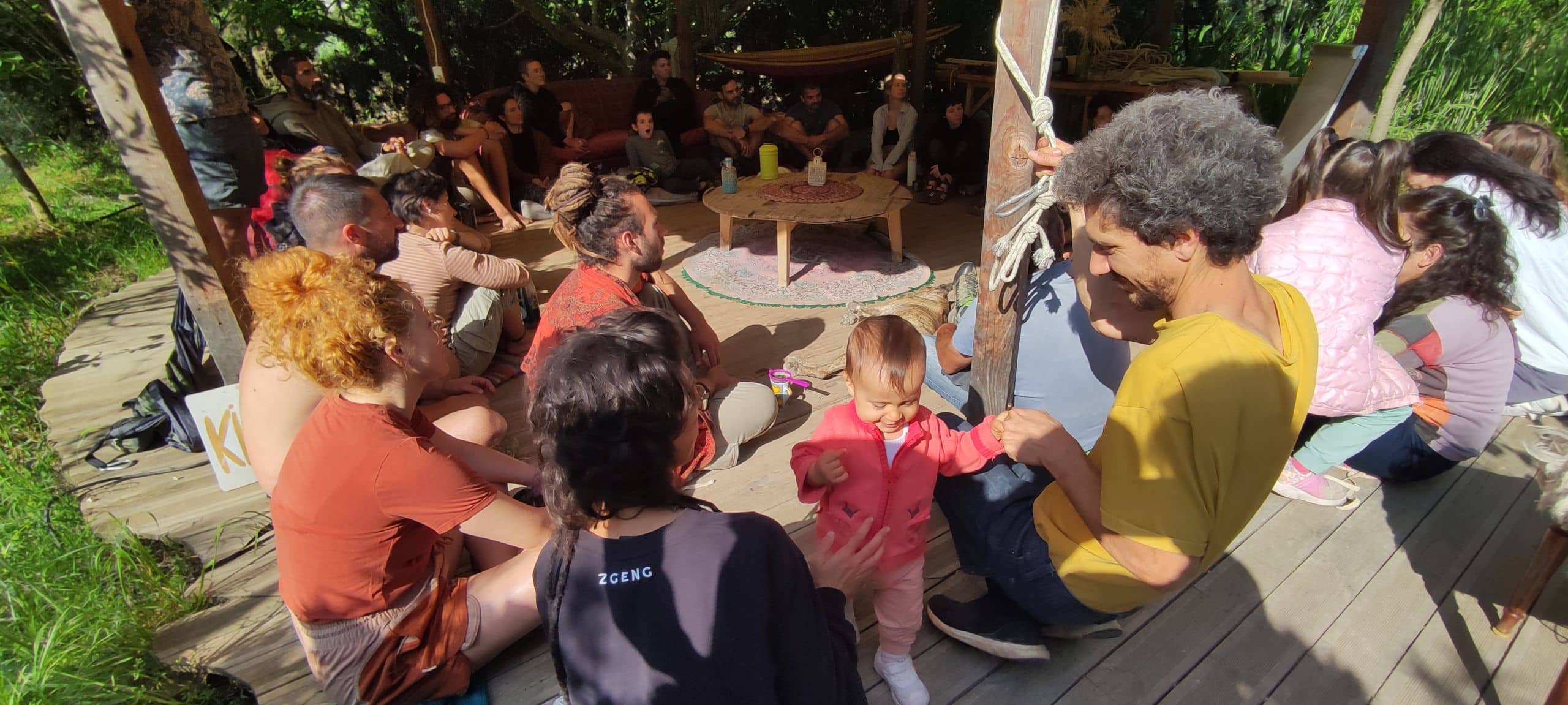
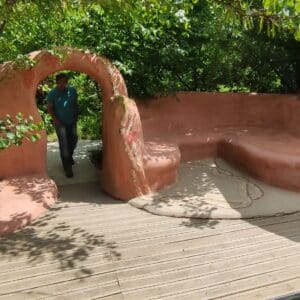
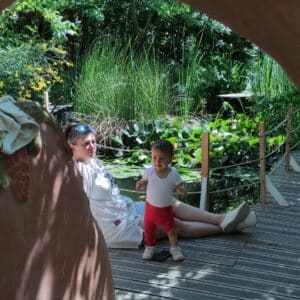
There were shady arbors, cob benches and walls, little ponds hidden among the vegetation, and a wonderful open yurt that served as a communal chill-out space.
And then there were the houses.
Scattered throughout the grove were dozens of small buildings made from natural and reclaimed materials, almost every one experimenting with a different idea. Some were built almost entirely from reclaimed materials. Others incorporated old clothes. Some stood proudly above ground, while others disappeared partly into it.
One unfinished house immediately caught my attention. It was being built with EcoCocon straw-bale panels and insulation — very close to the kind of house I dream of building one day.
Next to the campsite was also a beautiful syntropic garden. Having previously worked on a very young syntropic system, it was fascinating to see what happens after some time has passed: how the layers develop, how plants find their roles, and how elements that seem to have one purpose in the beginning gradually start doing several jobs at once.

Time to get muddy
I wasn’t completely new to natural building. I had already attended a short workshop with Susan Hagan in Hotnitsa, Bulgaria, so I knew one important thing:
Natural building is hard work.
Still, I was surprised by the programme at Cob. The two weeks were much more doing than talking.
Our mission was ambitious: clear the remains of an old stone house and begin bringing it back to life.
And after spending far too much of my recent life sitting at a desk and staring into a computer screen, physical work felt strangely wonderful. Getting my hands — and eventually almost everything else — covered in mud while my muscles remembered that they existed was exactly what I needed.
Clay, cob and 1,500 bricks
The first few days were a beautiful mixture of controlled chaos.
Some people cleared the ruins. Some mixed cob. Others made bricks. If you got tired of one job — physically or mentally — you could simply move to another team.
One of the more adventurous tasks was going to the nearby lake to collect good-quality clay. It’s difficult to make “collecting mud from a lake” sound exciting, but somehow it was.
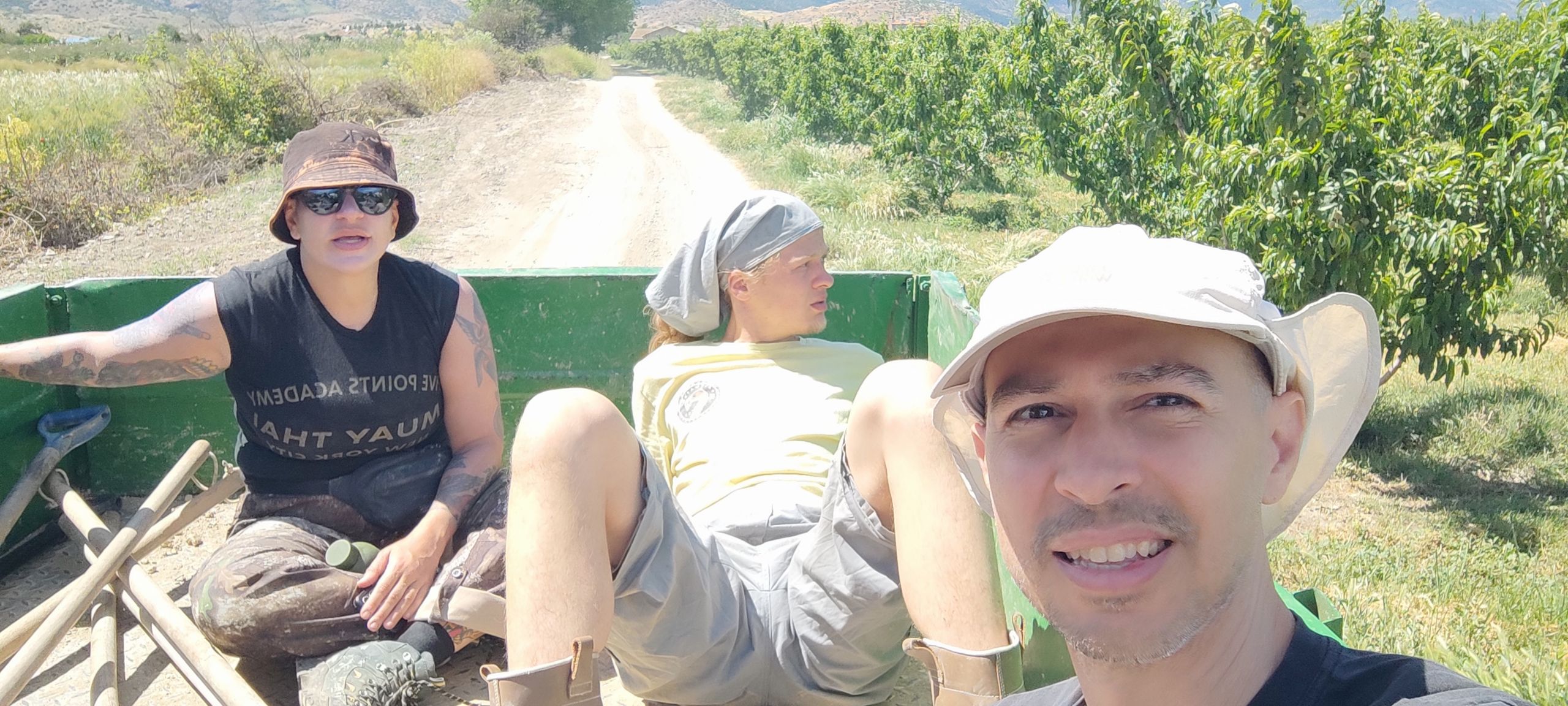
Our rhythm worked surprisingly well. We did the heavier practical work in the morning, slowed down during the hot afternoon for rest and theory, and then returned for a shorter work session in the evening.
Little by little, piles of earth, sand, clay and straw turned into building material.
By the end of the preparation stage, we had made around 1,500 cob bricks and cleared enough of the old structure to begin the actual reconstruction.
Finding my place in the mud factory
Once construction really started, we ran into a very practical problem: there were around 30 of us, and the building site simply wasn’t big enough for 30 enthusiastic people to simultaneously build a small house.
So I found my niche.
I joined the supply side of the operation, bringing raw materials and producing cob on a nearby meadow. Basically, while others became natural builders, I became part of the mud factory.
And I loved it.
There is something deeply satisfying about taking sand, clay, straw and water — ridiculously simple materials — and turning them into something that can become a wall and potentially stand there for generations.
A house comes back to life
Watching the house slowly emerge from the ruins was probably my favorite part of the whole experience.
It wasn’t simply being rebuilt. It was gaining a completely different personality.
The original stone structure, which was used as animal shelter before its roof collapsed, gradually became something clean and beautiful, but still wonderfully hippie, handmade and slightly hobbit-like.
People brought their own ideas into it. An oval entrance appeared. A round window. Small ornaments and details began finding their way into the interior. Nothing felt perfectly standardized, and that was precisely what made it feel alive.
It was a building created not only from natural materials, but from the imagination and hands of a whole group of people.
The village around us
And Cob wasn’t happening in isolation.
Just beside our worksite was the village square, shaded by majestic plane trees. There was also the local tavern, which had been bought and restored by the Cob team.
Instead of allowing another village building to slowly disappear, they had brought it back to life.
It became one of the social hearts of the place: good food, people gathering around tables, conversations stretching into the evening and, every Sunday, live rebetiko — traditional Greek music with exactly the right amount of melancholy for sitting under huge trees with a drink after a week of mixing mud.
In a way, this was as interesting to me as the natural building itself.
Permaculture is often associated with gardens, food forests and ecological construction, but places need social ecosystems too. A restored tavern, music, food and somewhere for people to meet can regenerate a village just as surely as planting trees can regenerate a piece of land.
Not quite finished
Two weeks turned out to be both a long time and no time at all.
We didn’t manage to finish the roof or the interior of the house before we had to leave. But considering that we had started with the remains of an old stone building, the transformation was enormous.
Leaving something unfinished also had an unexpected advantage: the story continued without us.
In the following weeks and months, it was a pleasure to follow Cob’s social media and watch other hands continue what ours had started.
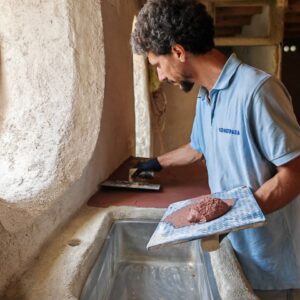
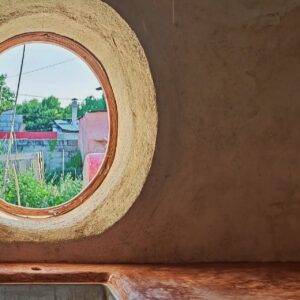
Somewhere in Greece there is now a little house made of stone, earth, straw, clay, imagination and the work of many different people.
And somewhere inside its walls is probably a bit of mud that passed through my hands.